DRUMMONDVILLE CA
DRUMMONDVILLE
HomeFoundationsBearing Capacity Analysis

Bearing Capacity Analysis in Drummondville

Site investigations you can build on.

LEARN MORE

Drummondville grew fast around its textile mills along the Saint-François River, and that industrial heritage left a mixed soil profile across the boroughs. Much of the downtown and industrial park sits on fluvial deposits — sands and silts with variable density — while residential zones to the north and east often encounter glacial till over clay. Before pouring a single footing, we run a bearing capacity analysis to check whether those layers can actually support the loads you plan to put on them. For shallow foundations we usually pair this with a plate load test to verify settlement directly on site, and when the soil profile is layered we recommend a CPT cone test to capture continuous strength data without gaps.
Illustrative image of Bearing capacity analysis in Drummondville
We calibrated our bearing capacity model against 12 years of site data in Drummondville — every project refines the correlation.

Our service areas

Methodology and scope

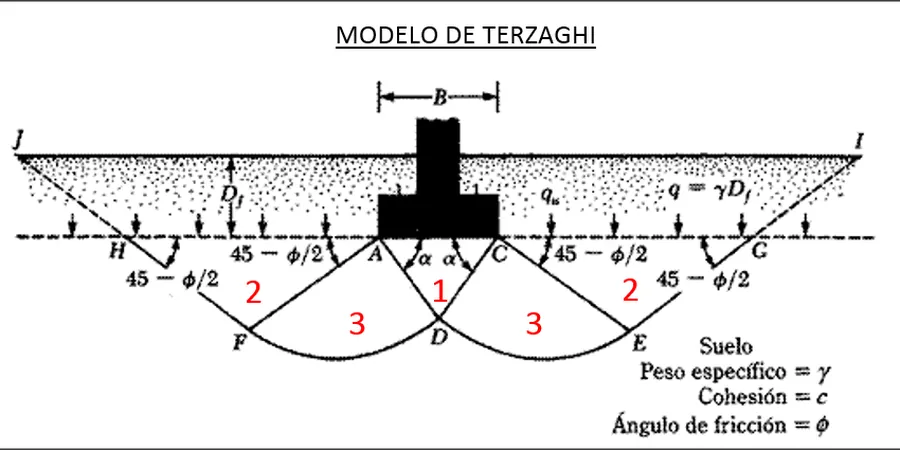
The Saint-François valley geology creates a distinct challenge: a soft clay crust between 2 and 5 meters deep overlays denser glacial till, and the water table sits only 1.5 to 3 meters below grade in many sectors. We calculate ultimate and allowable bearing capacity using Terzaghi's general shear failure method modified for local conditions, and we always verify against NBCC 2020 serviceability limits.

Key parameters we evaluate on site:
  • Undrained shear strength via field vane or triaxial test
  • Friction angle from SPT correlations calibrated to Drummondville till
  • Compressibility index for settlement prediction under working loads
For a recent commercial slab in the Saint-Charles district, the analysis showed that a 1.5 m wide strip footing could mobilize 220 kPa without exceeding 25 mm of differential settlement — that kind of number only comes from local calibration.
Technical reference — Drummondville

Local considerations

The most common mistake we see in Drummondville is assuming the clay crust alone can carry the load. Contractors sometimes skip the bearing capacity analysis because the crust feels stiff at the surface, but that same clay softens dramatically below 2 meters. We've seen slab settlements of 60 mm in two years on projects where the analysis was bypassed. The real risk isn't collapse — it's differential settlement that cracks partition walls and jams doors. A proper bearing capacity analysis catches that transition zone before the concrete is poured.

Need a geotechnical assessment?

Reply within 24h.

Email: contact@geotechnical-engineering.org

Applicable standards

NBCC 2020 (National Building Code of Canada), CSA A23.2-9A / CSA A23.2-9A / CSA A23.2-9A / CSA A23.2-9A / CSA A23.2-9A / ASTM D1586 (Standard Test Method for SPT), CSA A23.3-19 (Design of Concrete Structures), ASTM D1194-94 (Bearing Capacity of Soil under Static Load)

Technical parameters

ParameterTypical value
Soil type (typical depth)Clay crust 0-4 m, till 4-15 m
Undrained shear strength (Su)30-90 kPa in clay, 150+ kPa in till
Friction angle (φ)28°-36° in granular layers
Allowable bearing capacity180-280 kPa for shallow footings
Water table depth1.5-3.0 m (varies seasonally)

Frequently asked questions

How does bearing capacity analysis differ from a simple SPT test?

SPT gives you N-values at discrete depths, but bearing capacity analysis integrates those values with soil type, groundwater, and foundation geometry. It calculates the actual load the soil can support under your specific footing size and depth, including settlement checks — something a raw blow count alone cannot provide.

What soil conditions in Drummondville most affect bearing capacity?

The soft clay crust between 2 and 5 meters is the main variable. Below that, the glacial till is strong but can contain boulders that alter local bearing values. Also, the seasonal water table fluctuation in the Saint-François floodplain reduces effective stress — and capacity — during spring thaws.

What is the typical cost range for a bearing capacity analysis in Drummondville?

For a standard residential or light commercial project, expect between CA$940 and CA$2,050 depending on the number of test pits, SPT boreholes, and laboratory tests required. Larger sites with variable soils may run higher.

How long does the bearing capacity analysis take from site work to report?

Fieldwork usually takes one day for a typical lot. Laboratory testing and analysis add another 5 to 7 business days. We prioritize Drummondville projects so you have the numbers before excavation begins.

Location and service area

We serve projects across Drummondville.

Location and service area