DRUMMONDVILLE CA
DRUMMONDVILLE
HomeGround improvementGeotechnical Drainage Design

Geotechnical Drainage Design in Drummondville – Controlling Groundwater on the Saint-François Floodplain

Site investigations you can build on.

LEARN MORE

A common mistake we see on Drummondville projects is assuming the water table stays constant year-round. Builders dig a dry pit in August, pour the foundation, then face a flooded basement by spring thaw. That happens because the Saint-François River floodplain responds to snowmelt and heavy rain faster than most soil reports predict. A proper geotechnical drainage design must account for seasonal fluctuation, not just a single piezometer reading. We combine long-term monitoring with transient flow analysis to get the real picture. Before laying pipe, we also check the soil's filtration behavior through a permeability lab test to avoid clogging and long-term failure.
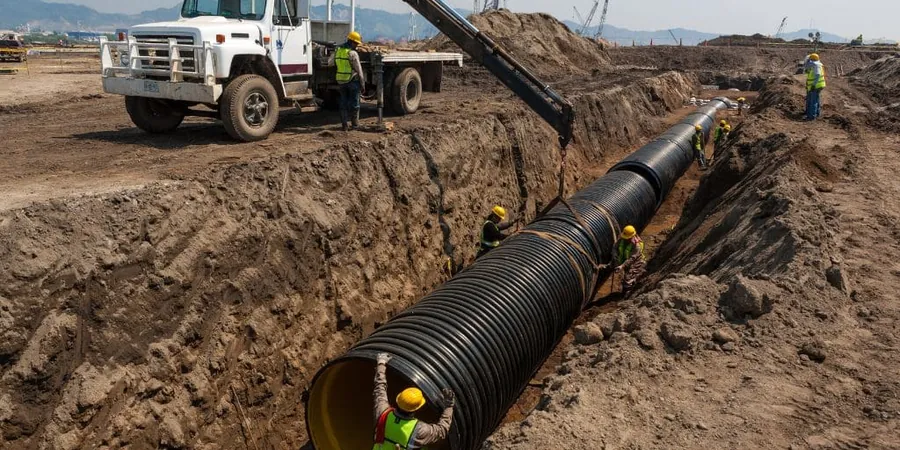
Illustrative image of Geotechnical drainage design in Drummondville
A 3-meter seasonal water table rise can double horizontal pressure on a retaining wall. Drainage design is the only reliable way to control it.

Our service areas

Methodology and scope

Drummondville sits at roughly 90 meters above sea level, but the water table in the river valley can rise 3 to 4 meters during spring runoff. That kind of fluctuation turns a stable excavation into a mud pit overnight. Our team tailors the geotechnical drainage design to the actual stratigraphy found on site. We install vibrating-wire piezometers to track pore pressure in real time. When the soil has high silt content — which is common in the Saint-François terraces — we specify prefabricated vertical drains instead of gravel trenches. The goal is simple: keep effective stress high and prevent liquefaction under cyclic loading.
Technical reference — Drummondville

Local considerations

NBCC 2020 requires that hydrostatic uplift be considered for any basement or below-grade structure in a floodplain zone. In Drummondville, that applies to most commercial lots within 200 meters of the Saint-François River. Ignoring this means the slab could crack or the entire building could float during a heavy rain event. A solid geotechnical drainage design reduces that risk to near zero by providing a permanent low-pressure path for water to escape. We follow CSA Z768 for well installation and seal design, ensuring the system works for decades without maintenance.

Need a geotechnical assessment?

Reply within 24h.

Email: contact@geotechnical-engineering.org

Applicable standards

NBCC 2020 – Hydrostatic uplift requirements (Section 4.1.6), CSA A23.3 – Foundation drainage and waterproofing, CSA Z768 – Standard practice for design and installation of groundwater monitoring wells

Technical parameters

ParameterTypical value
Design storm return period1-in-25-year to 1-in-100-year (NBCC 2020)
Minimum drain depth below slab300 mm (CSA A23.3)
Filter fabric opening size (AOS)No. 70 to No. 100 (ASTM D4751)
Geotextile permittivity≥ 0.5 sec⁻¹
Pipe perforation area≥ 2,000 mm²/m (ASTM F405)
Gravel drain permeability≥ 1×10⁻² m/s

Frequently asked questions

How much does a geotechnical drainage design cost in Drummondville?

For a typical residential or light commercial project in Drummondville, the cost ranges between CA$1,090 and CA$2,940. The final price depends on the number of piezometers, depth of installation, and whether lab permeability testing is required. Contact us for a site-specific quote.

When should I order the drainage design during the project timeline?

Order it right after the geotechnical soil investigation but before the foundation design. The drainage layout influences slab depth, waterproofing details, and even the retaining wall design. Waiting until excavation starts often forces costly rework.

Do I need a drainage design if my lot is on high ground away from the river?

Yes. Even upland sites in Drummondville can have perched water tables above clay or till layers. Without a proper design, water can build up behind a retaining wall or under a slab. We always check the seasonal high-water level before recommending a simplified system.

What happens if the drainage system clogs after a few years?

Clogging usually results from poor filter design or wrong geotextile selection. We specify an AOS that retains the in-situ soil particles while allowing water to pass. Systems designed this way typically last 30+ years without maintenance. We also recommend an inspection port for periodic checks.

Can I use the same drainage design for an addition as for the main building?

Not always. Additions often sit on different soil than the original building. The excavation may cut into a silt layer that drains differently. We prefer to run a separate piezometer reading for the addition area and adjust the design accordingly. It avoids surprises.

Location and service area

We serve projects across Drummondville.

Location and service area