DRUMMONDVILLE CA
DRUMMONDVILLE
HomeGeophysicsMicrotremores HVSR (Nakamura)

HVSR Microtremor Survey in Drummondville | Nakamura Method for Seismic Site Response

Site investigations you can build on.

LEARN MORE

We set up a portable three-component seismometer directly on the ground surface in Drummondville. No drilling, no heavy machinery — just a compact sensor that records ambient vibrations for 30 to 60 minutes per station. The equipment captures horizontal-to-vertical spectral ratios (HVSR) to identify the fundamental resonance frequency of the soil column. This non-invasive method works exceptionally well in Drummondville's glacial till and alluvial deposits overlying the St. Lawrence Lowlands bedrock. Before running the survey, we often cross-reference results with a MASW survey to obtain vs30/" data-interlink="1">shear wave velocity profiles, or integrate data from a dilatometer test for deeper stratigraphic detail. The whole field campaign typically takes one to two days for a standard residential lot.
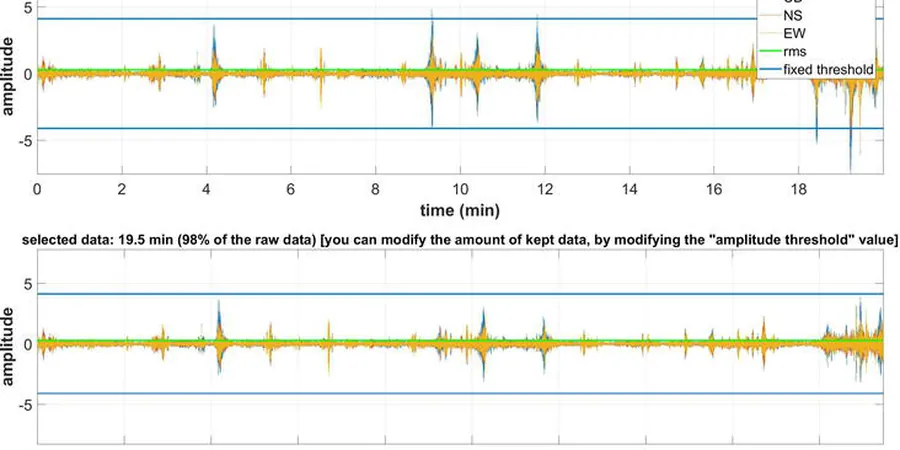
Illustrative image of HVSR microtremor survey (Nakamura method) in Drummondville
A 2 Hz soil resonance in Drummondville's clay basins can amplify seismic waves by a factor of three — HVSR catches that risk before the design is locked.

Our service areas

Methodology and scope

Drummondville sits on a mix of glacial till, marine clay from the Champlain Sea, and sand deposits from the ancient St. Lawrence River. The water table is shallow in low-lying areas, typically 2 to 4 meters deep. Our HVSR microtremor survey workflow includes:
  • Deploying 8 to 12 stations across the site to map lateral variability in resonance frequency
  • Recording ambient vibrations for 45 minutes per station to capture stable H/V spectral ratios
  • Processing data using proprietary software that filters out anthropogenic noise from traffic and machinery
We then correlate the H/V peak with the thickness of soft sediments. For Drummondville projects on thick clay sequences, we recommend pairing HVSR with a response spectrum analysis to calculate site-specific design spectra, and a permeability lab test if groundwater seepage is a concern.
Technical reference — Drummondville

Local considerations

NBCC 2020 and CSA A23.3 require site-specific seismic response values for buildings in Drummondville, particularly those in seismic site classes C, D, or E. The St. Lawrence Valley is a moderate seismic zone, and soft soil amplification can double or triple peak ground accelerations compared to bedrock. HVSR microtremor surveys identify the soil's natural frequency — if that frequency matches the building's fundamental frequency, resonance can cause severe structural damage. We've seen this firsthand in Drummondville projects where thick clay layers over sand produced 2 Hz resonance bands.

Need a geotechnical assessment?

Reply within 24h.

Email: contact@geotechnical-engineering.org

Applicable standards

NBCC 2020 (National Building Code of Canada) – Seismic site classification, CSA A23.3-19 – Design of concrete structures, seismic provisions, SESAME 2004 – Guidelines for H/V spectral ratio measurement and processing

Technical parameters

ParameterTypical value
Recording duration per station30 – 60 minutes
Sensor frequency range0.2 – 50 Hz
Number of stations per site8 – 12 (typical)
Soil resonance frequency range (Drummondville)0.8 – 6 Hz
Data processing standardSESAME guidelines (2004)

Frequently asked questions

How does an HVSR microtremor survey differ from a standard seismic refraction test?

HVSR measures ambient vibrations to identify soil resonance frequency without requiring an active seismic source. Seismic refraction uses a hammer or weight drop to measure P-wave or S-wave velocities. HVSR is faster (30–60 minutes per station) and more sensitive to soft soil layers over stiff bedrock — exactly the scenario in Drummondville's clay-over-sand profile.

What is the typical cost range for an HVSR microtremor survey in Drummondville?

For a standard residential or small commercial site with 8 stations, the cost ranges from CA$2,290 to CA$3,170. Larger sites with more stations or combined MASW surveys can increase the price. Contact us for a detailed quote based on your specific Drummondville project.

At what stage of a project should I schedule the HVSR survey?

Ideally during the preliminary geotechnical investigation, before structural design is finalized. The resonance frequency data directly informs the building's natural period and seismic base shear calculations. In Drummondville, we recommend running HVSR right after the desktop study and before any intrusive borings, so the results can guide drilling locations and depths.

Can HVSR detect liquefaction potential in Drummondville soils?

Indirectly, yes. HVSR identifies soft soil layers (clay, silt, loose sand) that are susceptible to liquefaction during seismic shaking. However, liquefaction triggering assessment requires additional data — such as SPT blow counts, CPT cone resistance, and vs30/" data-interlink="1">shear wave velocity — to apply the NCEER or Youd-Idriss methods. We always pair HVSR results with cone penetration testing or SPT for a complete liquefaction evaluation.

Location and service area

We serve projects across Drummondville.

Location and service area