DRUMMONDVILLE CA
DRUMMONDVILLE
HomeGround improvementEspecificación de geomallas

Geogrid Specification for Drummondville: Technical Requirements and Applications

Site investigations you can build on.

LEARN MORE

The clay-rich glacial till and marine deposits underlying Drummondville create demanding conditions for mechanically stabilized earth (MSE) walls and reinforced slopes. Winter freeze-thaw cycles and heavy spring runoff further test the long-term integrity of geosynthetic reinforcement. A precise geogrid specification must account for the region's frost depth of roughly 1.8 meters and the moderate seismic hazard classification per NBCC 2020. Before selecting a geogrid, practitioners typically run a granulometría to classify the backfill material, ensuring compatibility with the reinforcement aperture size and preventing clogging or excessive particle interlock.
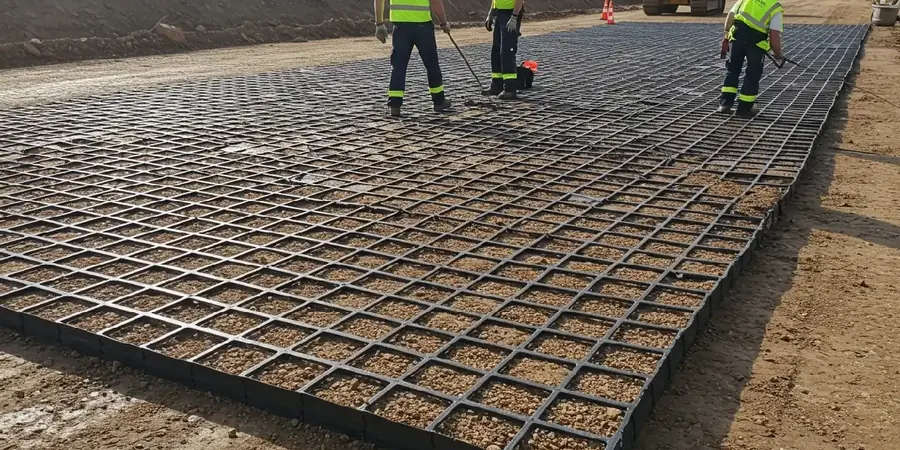
Illustrative image of Geogrid specification in Drummondville
Geogrid creep reduction factors in Drummondville must account for sustained sub-zero loading and 1.8m frost depth per NBCC 2020.

Our service areas

Methodology and scope

A common oversight in Drummondville is specifying a geogrid with inadequate creep reduction factor for sustained loads at sub-zero temperatures. Uniaxial geogrids for wall facing connections require a minimum ultimate tensile strength of 50 kN/m per the AASHTO M288 standard, but local practice often demands higher values due to the compressible clay foundation. The design must also consider differential settlement at the transition between till and bedrock, which can be assessed through a placa-de-carga test. Key specification parameters include:
  • Ultimate tensile strength (ASTM D6637)
  • Junction efficiency (≥ 90% per GRI GG2)
  • Soil-geogrid pullout resistance (ASTM D6706)
  • UV stability for exposure periods over 30 days
For steep slopes over 4 meters in height, a estabilidad-taludes analysis incorporating the geogrid reinforcement layers is mandatory.
Technical reference — Drummondville

Local considerations

Installing a geogrid with roll lengths over 30 meters on Drummondville's clay slopes requires careful staging. The equipment includes a tractor-mounted deployment frame with a tensioning bar that maintains uniform elongation during backfill placement. If the geogrid is allowed to wrinkle or lose tension, the reinforced zone loses composite action. On the marine clay east of the Saint-François River, differential settlement can induce tensile strains exceeding the geogrid's elongation capacity. An asentamientos analysis using consolidation test data from undisturbed samples should precede final specification to avoid serviceability failures.

Need a geotechnical assessment?

Reply within 24h.

Email: contact@geotechnical-engineering.org

Applicable standards

NBCC 2020 (National Building Code of Canada) seismic and frost provisions, ASTM D6637 (Standard Test Method for Determining Tensile Properties of Geogrids), AASHTO M288 (Standard Specification for Geosynthetic Reinforcement of the Aggregate Base Course of Flexible Pavement Structures), GRI GG2 (Standard Test Method for Determination of Geogrid Junction Efficiency)

Technical parameters

ParameterTypical value
Minimum ultimate tensile strength (MD)50 kN/m (ASTM D6637)
Long-term design strength (LTDS)≥ 26 kN/m after creep + installation damage reduction
Soil-geogrid pullout resistance≥ 0.8 x tensile strength (ASTM D6706)
Frost depth for embedment1.8 m per NBCC 2020 Table E-1
UV exposure limit (uncovered)30 days per ASTM D4355

Frequently asked questions

What geogrid type is recommended for reinforced slopes in Drummondville's clay till?

Uniaxial high-density polyethylene (HDPE) geogrids with minimum ultimate tensile strength of 50 kN/m in the machine direction are standard for slopes exceeding 3 meters. The creep reduction factor must account for sustained sub-zero loading. Biaxial geogrids are used for shallow reinforced fills under roadways.

How does frost depth influence the geogrid specification in Drummondville?

Per NBCC 2020, the frost depth is 1.8 meters. The geogrid reinforcement layer must extend below this depth to prevent frost jacking of the reinforced soil mass. The embedment length calculation includes a 1.8 m frost protection zone plus the standard pullout resistance length.

What is the typical cost range for a geogrid specification and testing program in Drummondville?

Material testing and specification development typically ranges between CA$620 and CA$1,710 depending on the number of geogrid types evaluated and the complexity of the reinforced soil structure. On-site quality assurance adds additional costs based on project duration.

Which ASTM standards apply to geogrid specification for MSE walls in Quebec?

Primary standards include ASTM D6637 for tensile properties, ASTM D6706 for pullout resistance, and ASTM D5262 for creep testing. The Quebec Construction Code references AASHTO M288 for geosynthetic reinforcement in transportation applications, which is the dominant standard for Drummondville highway projects.

Location and service area

We serve projects across Drummondville.

Location and service area