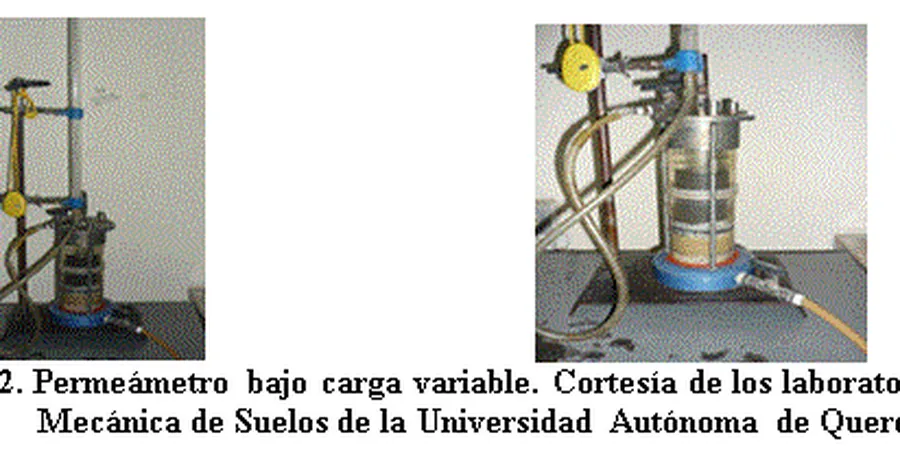
A falling head permeameter sits on the lab bench in Drummondville. The standpipe is filled with de-aired water. A soil sample trimmed from a Shelby tube is sealed inside the cell. We apply a known hydraulic gradient and measure the drop in head over time. For sands and gravels, a constant head setup uses a Mariotte bottle to maintain steady flow. Both methods follow ASTM D2434-19. The key output is hydraulic conductivity, or k-value, in cm/s. Drummondville soils range from Saint-Nicéphore sands to Saint-Cyrille clays. Each requires a different test configuration. Before the lab test, we often correlate results with a permeability field test to compare in-situ versus lab values. The lab gives controlled conditions; the field gives real stratigraphy.
Hydraulic conductivity in Drummondville clay can be 10,000 times lower than in Saint-Nicéphore sands, making lab permeability essential for foundation drainage design.