DRUMMONDVILLE CA
DRUMMONDVILLE
HomeFoundationsRaft/Mat Foundation Design

Raft/Mat Foundation Design in Drummondville – Geotechnical Expertise for Heavy Loads

Site investigations you can build on.

LEARN MORE

Drummondville sits at an elevation of roughly 100 meters above sea level, where the Saint-François River has deposited layers of sand, silt, and clay over millennia. For any structure requiring uniform load distribution—especially mid-rise buildings or heavy equipment pads—a properly engineered raft/mat foundation becomes essential. In our experience, the local stratigraphy often presents compressible fine-grained soils near the surface, making a mat solution a logical choice to spread column loads and reduce differential settlement. Before finalizing the design, we always recommend a thorough study of soil classification to identify plasticity and consolidation characteristics, and a plate load test to verify bearing capacity in situ.
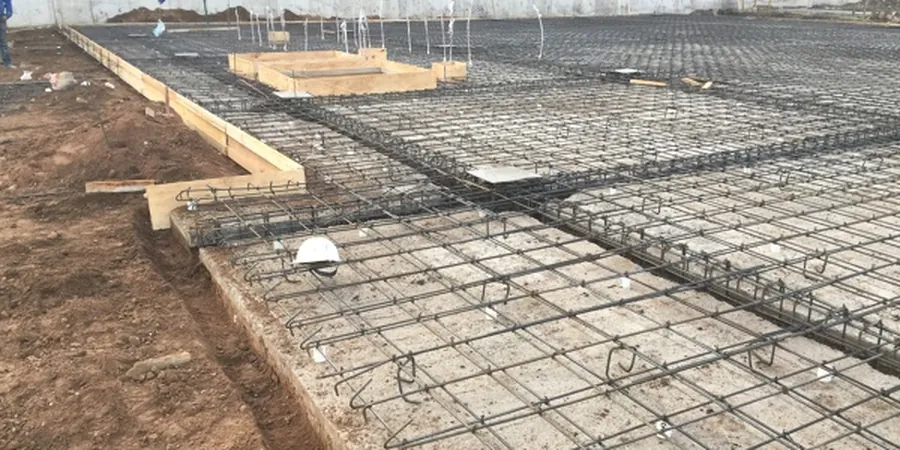
Illustrative image of Raft/mat foundation design in Drummondville
A properly designed raft foundation in Drummondville can reduce differential settlement to under 25 mm, even on soft clay deposits up to 8 meters thick.

Our service areas

Methodology and scope

The climate in Drummondville, with freeze-thaw cycles lasting from November to April, directly influences how a raft foundation performs over time. Frost heave in the upper silty clays can exert upward forces on the slab edge, so we incorporate a granular capillary break and sometimes rigid insulation to keep frost penetration below the mat. Meanwhile, the high water table near the Saint-François floodplain demands careful drainage design—a raft that sits in saturated soil without proper under-slab drainage can suffer from hydrostatic uplift. We typically pair the mat with a permeability field test to measure hydraulic conductivity and a dilatometer test when we need precise modulus values for the underlying dense till.
  • Frost protection: 600 mm granular blanket with XPS insulation
  • Drainage: perimeter French drains discharging to municipal storm system
  • Reinforcement: CSA G30.18 Grade 400W bars, typically 20M at 300 mm spacing
Technical reference — Drummondville

Local considerations

A 10-story residential project on rue des Forges encountered a classic Drummondville problem: a 6-meter layer of soft clay over a stiff till, with the water table only 1.2 meters deep. The original design called for isolated footings, but after our site investigation revealed consolidation settlements exceeding 80 mm, the team switched to a raft/mat foundation. Even so, the mat needed to be thickened under the core to control punching shear, and we installed vertical Wick drains to accelerate pre-consolidation. Without that redesign, differential settlement would have cracked the partition walls within two years.

Need a geotechnical assessment?

Reply within 24h.

Email: contact@geotechnical-engineering.org

Applicable standards

NBCC 2020 (National Building Code of Canada), CSA A23.3-19 (Design of Concrete Structures), ASTM D1196-12 (Plate Load Test – for modulus of subgrade reaction), Canadian Foundation Engineering Manual (CFEM) 4th Edition

Technical parameters

ParameterTypical value
Minimum mat thickness400 mm (16 in)
Typical reinforcement ratio0.3% – 0.6% per direction
Allowable bearing pressure (design)80 – 150 kPa
Modulus of subgrade reaction (k)15 – 40 MN/m³
Frost depth (design)1.8 m below grade
Concrete strength (minimum)25 MPa at 28 days

Frequently asked questions

What is the typical cost range for a raft foundation design study in Drummondville?

For a standard residential or light-commercial raft up to 500 m², the geotechnical investigation plus structural design typically falls between CA$1.640 and CA$6.040. Larger industrial mats or projects requiring deep consolidation analysis can exceed this range.

How thick does a raft foundation need to be for a 6-story building on Drummondville clay?

In our experience, a 400 to 600 mm thick mat is common for 6-story buildings, provided the bearing pressure stays under 120 kPa. The exact thickness depends on column spacing, clay compressibility, and the presence of a stiff bearing stratum below the soft layer.

Can a raft foundation be designed without a site-specific soil investigation?

Technically yes, but it is risky and often non-compliant with NBCC 2020. Without knowing the clay's pre-consolidation stress, settlement predictions can be off by 50% or more. We always recommend at least two boreholes to a depth of 1.5 times the mat width.

What is the difference between a raft foundation and a mat foundation?

In Canadian practice the terms are used interchangeably. Both refer to a single continuous concrete slab that supports multiple columns or walls. The design approach—elastic plate on springs, settlement control, reinforcement detailing—is identical regardless of what you call it.

Location and service area

We serve projects across Drummondville.

Location and service area