DRUMMONDVILLE CA
DRUMMONDVILLE
HomeSlopes & WallsSlope Stability Analysis

Slope Stability Analysis in Drummondville – Geotechnical Expertise for Safer Sites

Site investigations you can build on.

LEARN MORE

A common mistake we see from contractors working in Drummondville is assuming that a slope that looks stable after a dry week will hold up during spring thaw or after a heavy rainfall event. The region's glacial till and clay layers behave very differently once pore pressures rise, and we have been called to several sites where a cut slope failed overnight because nobody checked the factor of safety under saturated conditions. That is why we always recommend a proper slope stability analysis before any excavation deeper than 1.5 meters, especially when the site borders the Saint-François River floodplain. By combining field data from a density cone sand replacement test with laboratory shear strength parameters, we can model realistic failure surfaces and give you numbers you can trust.
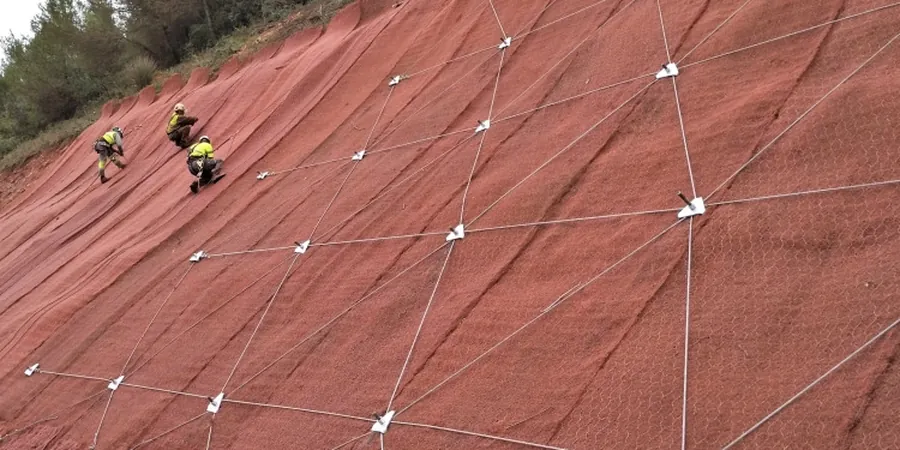
Illustrative image of Slope stability analysis in Drummondville
A slope that survives a dry week can fail overnight during spring thaw when pore pressures rise in Drummondville's silty clay.

Our service areas

Methodology and scope

Drummondville sits at an elevation of around 90 meters above sea level, with a subarctic climate that brings freeze-thaw cycles from November through April. Those cycles directly affect slope behavior because ice lens formation in the silty clay layers creates temporary perched water tables that reduce effective stress. In our slope stability analysis for local projects, we incorporate the NBCC 2020 seismic provisions since the region falls under moderate seismicity, and we use the Bishop simplified method for circular failure surfaces or the Spencer method for non-circular sliding blocks when the stratigraphy includes varved clay. We also run the analysis with both short-term undrained conditions and long-term drained conditions, because what works for a temporary construction slope may not hold for a permanent embankment. On several Drummondville sites we combined this with electrical resistivity tomography to map shallow groundwater flow paths before finalizing the model. Our team relies on the Mohr-Coulomb failure criterion calibrated against direct shear tests on undisturbed samples taken from the actual slope face. The result is a clear report showing the critical slip surface, the calculated factor of safety, and recommendations on benching or reinforcement if needed.
Technical reference — Drummondville

Local considerations

We worked on a site near the intersection of Boulevard Saint-Joseph and Rue Heriot where a contractor had cut a 4-meter slope for a commercial basement without any geotechnical input. Three days later, after a 30-millimeter rainfall, a wedge failure slid into the excavation and damaged the shoring. The owner had to bring in extra equipment, delay the pour, and pay for a redesign. That is the kind of scenario we help you avoid. In Drummondville, the combination of low-plasticity clay and silt layers with varying moisture content creates conditions where progressive failure can develop slowly and then accelerate fast. A proper slope stability analysis identifies those risks before the shovel hits the ground.

Need a geotechnical assessment?

Reply within 24h.

Email: contact@geotechnical-engineering.org

Applicable standards

NBCC 2020 (National Building Code of Canada) – seismic & gravity loads, ASTM D6528-17 – consolidated undrained triaxial compression test on cohesive soils, CSA A23.3-19 – design of concrete structures for retaining and foundation walls, FHWA-NHI-05-089 – slope stability reference manual (method guidance)

Technical parameters

ParameterTypical value
Analysis methodBishop simplified / Spencer / Morgenstern-Price
Failure surface typeCircular or non-circular
Shear strength modelMohr-Coulomb (c, phi)
Pore pressure conditionUndrained (short-term) / Drained (long-term)
Seismic coefficient (kh)Per NBCC 2020 spectral acceleration
Minimum target FoS1.3 (temporary) / 1.5 (permanent)

Frequently asked questions

What is the minimum factor of safety required for a permanent slope in Drummondville?

We typically target 1.5 for permanent slopes under static conditions, and 1.1 for pseudo-static seismic loading per NBCC 2020. Temporary construction slopes can be designed to 1.3, provided drainage is controlled and monitoring is in place.

How long does a slope stability analysis take for a typical residential project?

For a basic assessment with one or two boreholes, we usually deliver results within 5 to 7 business days. A detailed study with laboratory testing and seismic evaluation can take 10 to 14 days, depending on the number of samples and the complexity of the stratigraphy.

Do you use the same analysis method for clay slopes and sandy slopes in Drummondville?

No. For clay-rich soils we apply the Bishop simplified method with undrained shear strength (Su) and consider progressive failure. For sandy or granular slopes we use the Spencer or Morgenstern-Price method with effective stress parameters, because pore pressure changes have a bigger impact on the factor of safety.

What information do you need from me to start a slope stability study?

We need the site location, proposed slope geometry (height and angle), any existing borehole logs or test pit records, and the intended use of the excavation or embankment. If you have a geotechnical report from a nearby lot, that helps us calibrate the model faster.

Can you analyze a slope that already shows cracks or signs of movement?

Yes, and we recommend doing it as soon as possible. We can install inclinometers or surface monitoring points to measure movement rates, then back-analyze the failure surface using the observed geometry. This tells us whether the slope is stable at a reduced factor of safety or if remediation is urgent.

Location and service area

We serve projects across Drummondville.

Location and service area