DRUMMONDVILLE CA
DRUMMONDVILLE
HomeSlopes & WallsSlope Stabilization Design

Slope Stabilization Design in Drummondville

Site investigations you can build on.

LEARN MORE

Drummondville sits on the St. Lawrence Lowlands, where thick marine clay deposits — known as Leda clay — dominate the subsurface. These clays are highly sensitive and can lose strength rapidly when disturbed, making slope stabilization design a critical step before any cut or fill operation. Freeze-thaw cycles add another layer of complexity, with spring thaws often triggering shallow slides. Our team evaluates each site using borehole data and lab testing to model failure surfaces accurately before recommending a solution. Complementing this work with a [MASW survey](/masw-vs30/) helps us map stiffness contrasts across the property without drilling extra holes.
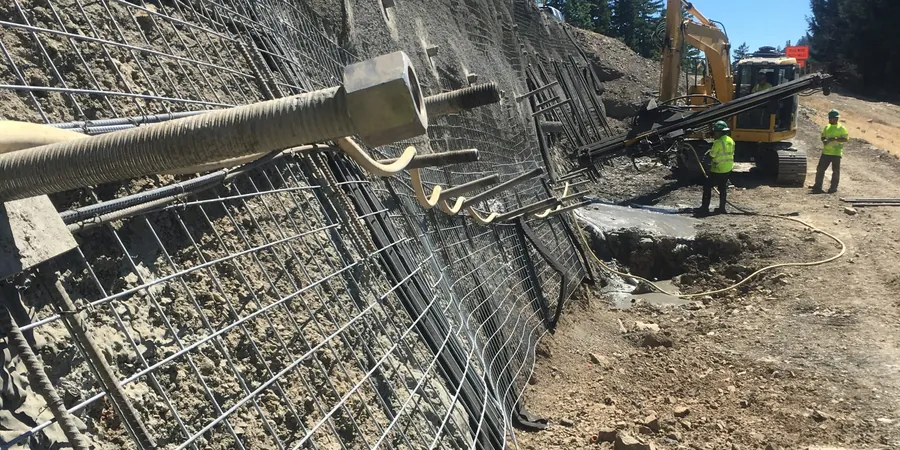
Illustrative image of Slope stabilization design in Drummondville
Leda clay in Drummondville can lose 80% of its undrained shear strength upon remolding — that is why stabilization must start with a proper site investigation.

Our service areas

Methodology and scope

Soils near the Saint-François River differ sharply from those on the plateau north of Autoroute 20. Riverside lots often contain soft clay interbedded with sand lenses, while upland areas show stiffer glacial till closer to the surface. For a slope stabilization design in Drummondville, we must account for these lateral variations. Our process includes sampling at multiple depths, running consolidated-undrained triaxial tests, and then back-analyzing the critical slip surface. When groundwater seepage is present, we integrate drainage geotechnical solutions to lower pore pressures before finalizing the reinforcement scheme.
Technical reference — Drummondville

Local considerations

Drummondville expanded rapidly after the 1960s, with new subdivisions pushing into former agricultural land underlain by soft clay. Many of these areas now experience slow downslope creep, especially after heavy rain or rapid snowmelt. Ignoring a proper slope stabilization design here can lead to cracked foundations, tilted retaining walls, and even sudden retrogressive slides. The 2017 landslide near Saint-Adolphe-d'Howard serves as a regional reminder of what happens when drainage and slope geometry are underestimated. Our designs prioritize water control and staged construction to keep risks low.

Need a geotechnical assessment?

Reply within 24h.

Email: contact@geotechnical-engineering.org

Applicable standards

NBCC 2020 (National Building Code of Canada), CSA A23.3-19 (Concrete Design for Retaining Walls), ASTM D3080-18 (Direct Shear Test of Soils), FHWA-NHI-14-007 (Soil Nail Walls Reference Manual)

Technical parameters

ParameterTypical value
Soil type encounteredMarine clay (Leda), glacial till, sand lenses
Typical slope height3 m to 15 m
Undrained shear strength (Su)20 kPa to 80 kPa
Factor of safety target1.3 (static), 1.1 (seismic)
Groundwater depth range1.5 m to 6.0 m below surface
Stabilization methods usedSoil nails, geogrids, drainage blankets, buttress fills

Frequently asked questions

What makes slope stabilization design in Drummondville different from other Quebec cities?

The presence of Leda clay — a highly sensitive marine clay that loses strength when disturbed. Freeze-thaw cycles and high water tables during spring melt create unique failure conditions that require site-specific modeling and drainage measures.

How much does a typical slope stabilization design cost in Drummondville?

For a standard residential project with one or two slope sections, clients can expect a range between CA$2.390 and CA$9.080. Larger commercial sites with multiple benches and drainage networks fall at the higher end of that range.

What geotechnical tests are essential before designing slope stabilization?

We require at least two boreholes per slope section, unconfined compression tests on clay samples, direct shear tests on granular layers, and a piezometer reading to establish the groundwater level. For critical slopes, we also run consolidated-undrained triaxial tests.

How long does a slope stabilization design project take from start to finish?

A typical project takes 3 to 5 weeks: field investigation and lab testing during weeks 1–2, modeling and design iterations in week 3, and a final report with construction drawings by week 4 or 5. Urgent cases can be expedited when drill rigs are available.

Location and service area

We serve projects across Drummondville.

Location and service area

Explanatory video